Full-Day Nairobi
National Park Safari
Seven to eight hours of uninterrupted wilderness — from the lion territories at dawn to the rhino zones at dusk — with a packed picnic lunch at the dam and the Nairobi skyline always on the horizon.
The Full-Day Experience
Everything the Park Has to Offer, All in One Day
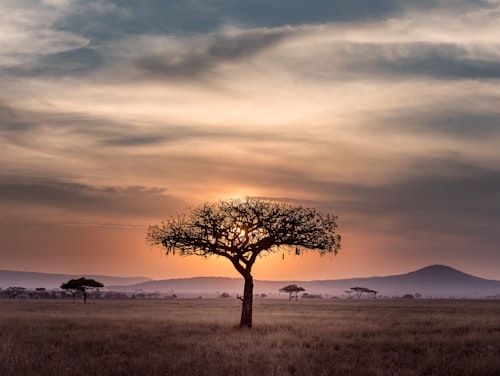
Nairobi National Park rewards those who give it time. While a half-day game drive offers a taste of the wildlife corridor that runs right to the city’s edge, the full-day safari unlocks the complete circuit — the open grassland plains where lions patrol at dawn, the rhino sanctuary’s acacia-fringed interior, the hippo pools where the Athi River slows to mirror glass, and the remote dam at the park’s far southern reach where elephant corridors once met the Kitengela plains.
Your guide picks you up from your Nairobi hotel as first light touches the Ngong Hills. Entry is through the Main Gate on Lang’ata Road — 7 kilometres from the CBD, 25 minutes from JKIA — and from there the full game circuit opens up. With seven to eight hours inside the park rather than three, your guide has the time to track, wait, and position — not just pass through. The difference in sightings is profound.
A packed picnic lunch is included, eaten at one of the park’s dam-side picnic sites — one of the few places in any safari park in Africa where you can watch hippos wallow while eating lunch with a glass-and-steel skyline behind them.


Your Day, Hour by Hour
5:45 – 6:00 AM
Hotel Pickup
Your guide collects you from your hotel in a comfortable pop-up roof Land Cruiser. Nairobi is quiet at this hour. The Ngong Hills appear above the treeline as you take Lang’ata Road south.
6:15 – 6:30 AM
Main Gate Entry & Route Briefing
Your guide handles all KWSPay entry tickets. Inside the gate, a five-minute briefing covers the day’s circuit, current wildlife intelligence from other guides, and the park’s single-entry rule.
6:30 – 9:00 AM
Dawn Predator Circuit — Open Grassland Plains
The first three hours are prime predator time. Lions are active just after sunrise, often visible on the open plateau between the Main Gate and the Athi River track. Your guide reads fresh tracks and coordinates with the guide network for real-time positions. This is when cheetah and leopard sightings are most likely.
9:00 – 10:30 AM
Rhino Zone — Kifaru Ark & Sanctuary Interior
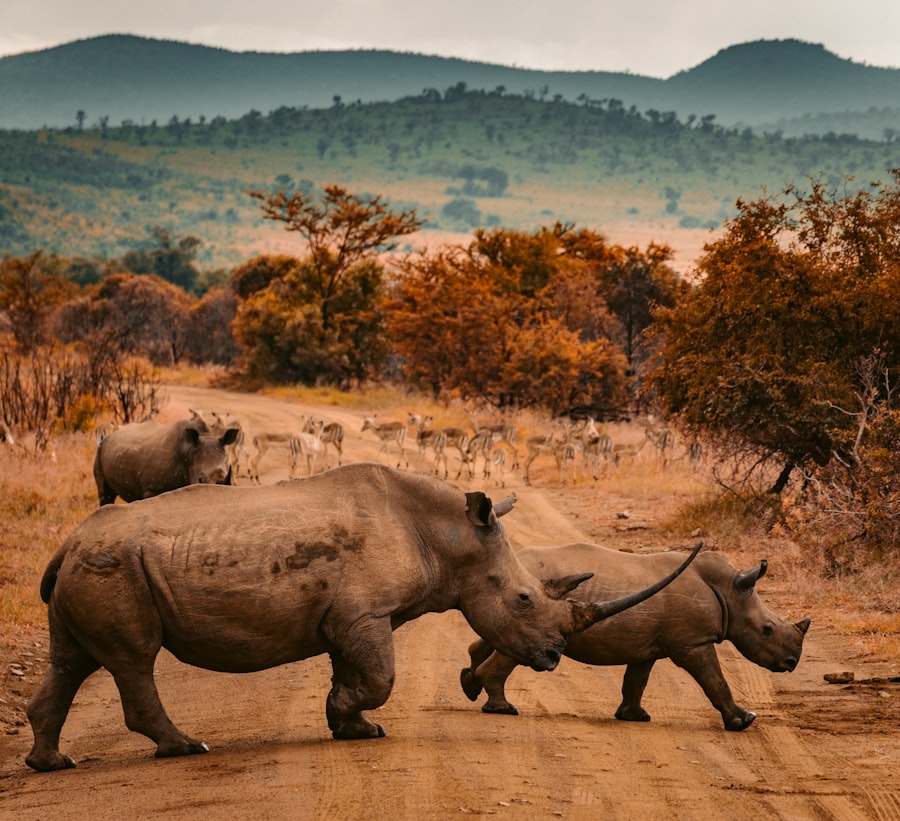
The park’s black and white rhino population is concentrated in the interior sanctuary. Access requires staying on designated tracks. Your guide knows the watering patterns by season — morning is when rhinos typically move to browse. Buffalo herds and eland are frequent companions in this zone.
10:30 AM – 12:00 PM
Southern Dam Tracks — Herbivore Herds & Birdlife
The track south toward the Athi and Mbagathi rivers crosses the park’s finest zebra and wildebeest grassland. Giraffes — the Maasai subspecies — are almost always present. With 500+ bird species recorded, your guide will point out migrants and residents: crowned crane, secretary bird, vultures riding thermals above the escarpment.
12:00 – 1:00 PM
Picnic Lunch at the Dam
Your packed lunch — included in the tour price — is taken at Kingfisher Picnic Site or Mokoyiet Dam, depending on wildlife positioning. Hippos are usually visible from the picnic area. This is the only moment you leave the vehicle; your guide remains present throughout. The Nairobi skyline frames the opposite treeline.
1:00 – 2:30 PM
Afternoon Circuit — Hippo Pool, Ivory Burning Monument
After lunch the afternoon light shifts golden. The route takes in the Hippo Pool walking trail (optional, accompanied by your guide) and a stop at the Ivory Burning Site Monument — where 11 tonnes of confiscated ivory were burned in 1989, sending a message to the world’s poaching networks. Your guide’s conservation context here is among the most memorable parts of the day.
2:30 – 3:30 PM
Return Circuit & Gate Exit
The homeward track is rarely wasted — midday-sleeping lions become visible in the late afternoon shade, and the park’s eastern edge often produces warthog family groups. Exit via Main Gate; departure time can be adjusted by prior arrangement.
3:30 – 4:00 PM
Hotel Drop-Off
Return to your hotel or a specified Nairobi drop-off point. Optional extension: visit the David Sheldrick Wildlife Trust elephant orphanage (11 AM window requires pre-booking — see our Combo Tour) or the Nairobi Giraffe Centre.
What’s Covered
Inclusions & Exclusions
Wildlife You’ll Encounter
The Animals of Nairobi National Park
Nairobi National Park holds 4 of the Big Five — lion, leopard, buffalo, and rhino. Elephants are absent (the southern corridor that once connected to the Amboseli ecosystem has been fragmented by development), but the park compensates with some of Africa’s most accessible black and white rhino viewing. A full-day tour maximises time in each species’ zone at the right hour.
Black Rhino
Sighting probability (full-day)

Lion
Sighting probability (full-day)
Maasai Giraffe
Sighting probability (full-day)
Burchell’s Zebra
Sighting probability (full-day)

Hippo
Sighting probability (full-day)

Cheetah
Sighting probability (full-day)
Sighting probabilities are indicative averages across all seasons. Full-day tours consistently outperform half-day tours by 40–60% across all species categories. Read the full wildlife guide →
Guest Reviews
What Our Guests Say
★★★★★
“We saw three rhinos, two lion prides, and a cheetah — all before lunch. The picnic by the dam with hippos ten metres away is something I’ll describe to people for the rest of my life.”
★★★★★
“I’ve done the Masai Mara twice. This is different — there’s something surreal about watching a lion walk with Nairobi’s towers behind it. The full day is non-negotiable; the half-day simply can’t do it justice.”
★★★★★
“Our guide knew every bird by call before it was even visible. Seven and a half hours felt short. We had the rhino zone entirely to ourselves for over an hour — just silence, acacia trees, and two rhinos drinking.”
★★★★★
“Travelling with two young children (ages 6 and 9). Both were absolutely gripped the entire time. The packed lunch at the picnic site — hippos right there — had the children talking about nothing else for days.”
Questions & Answers
Everything You Need to Know
Why is a full-day tour better than a half-day for wildlife sightings? +
Because Nairobi National Park operates a strict single-entry policy, a half-day tour uses roughly 30–40% of the park’s total game circuit. A full-day tour covers the complete circuit — including the rhino sanctuary interior, the southern dam tracks, and the Hippo Pool area — zones that half-day tours either rush through or skip entirely. More time also lets your guide wait at a sighting rather than moving on due to schedule pressure. Our guide data consistently shows full-day tours produce 40–60% more species sightings per guest.
What is the single-entry rule and how does it affect my day? +
KWS prohibits vehicles from exiting and re-entering the park on the same ticket. This means that once you leave through any gate, your park visit is over for that day. It’s the reason we include a packed picnic lunch eaten inside the park — so you lose no time and no access by needing to exit for a meal. We plan the entire day to ensure you stay inside for the maximum possible game-viewing window. Learn more about park rules →
Can I combine the full-day tour with the Elephant Orphanage or Giraffe Centre? +
Yes, though logistics require careful planning. The David Sheldrick Wildlife Trust (elephant orphanage) has a single daily visitor window at 11 AM which means it cannot be added to a full-day tour that begins at 6 AM without exiting the park mid-morning. The better option is our dedicated Combined Attractions Tour, which sequences the Orphanage, Giraffe Centre, and a morning park game drive in the correct order. If you want to add the Giraffe Centre only (afternoon timing is flexible), let us know at booking and we will arrange it as a return-journey stop.
What vehicle will we be in? +
All full-day tours use a 4×4 pop-up roof Land Cruiser or equivalent safari vehicle with a minimum 250mm ground clearance — necessary for the park’s southern tracks during the wet season. The pop-up roof allows standing photography in all directions without opening a door or window. Vehicles hold a maximum of 6 guests per tour. Compare safari vehicle types →
What should I wear and bring? +
Neutral earth tones (khaki, olive, tan) are recommended — bright colours are not forbidden but are less comfortable in a safari context. Early mornings in the park can be cool even in Nairobi’s dry season; bring a light layer. Binoculars are provided on loan, but serious birdwatchers or photographers should bring their own. Sunscreen, insect repellent, and a hat are essential. Lunch is provided so you don’t need to bring food, but snacks are welcome. See the full packing list →
What’s the cancellation policy? +
Free cancellation up to 48 hours before departure. Between 24–48 hours: 50% refund. Less than 24 hours: no refund. We offer free date changes up to 24 hours before departure subject to availability. In the event of severe weather preventing safe game-driving (rare in Nairobi), we offer a full reschedule or refund at our discretion.
Ready to Go?
Seven Hours in Africa’s
Most Extraordinary Park
Nairobi National Park is 7 kilometres from the city centre. It contains lions, rhinos, leopards, hippos, and over 500 bird species. It asks only that you give it a full day.